- AddShortcut
- Posts
- Black Friday Holiday Shopping List
Black Friday Holiday Shopping List
Battle tested gear for betterness, cheapness, honesty and awesomeness by yours truly

Oltac Unsal
November 26, 2025

NVDA Iron Condor Set Up before Earnings
Did you make some cash with my NVDA tip last time? Selling volatility works because the world is really not as volatile as the news, polarization, marketing, attention deficit, bandwidth economics combined make it seem as if. Anyways, today I will give you ways to spend the cash you made. Holiday shopping especially during Black Friday with simple criteria for the list: gotta be better than the alternative, cheaper than the alternative, and tested rigorously like crazy by yours truly.
The Shaving Scam We All Fell For Somewhere along the way, shaving stopped being a simple mechanical act and turned into a long con. Gillette figured out early that the money wasn’t in the razor; it was in the blades. The classic razor-and-blades model wasn’t a business insight but a quiet tax on male complacency. First came the double edge. Cheap steel, sharp, effective. Then marketing realized it needed “innovation” to keep the margins climbing. Two blades. Three. Five. A vibrating handle. Aloe strips. A “heating bar.” Somehow a tool designed to cut hair became a theme park ride for your chin. Each new model was sold as progress. In reality, it was just a way to make you pay more for the same job your grandfather handled with steel, soap, and a steady wrist. Gillette didn’t betray us suddenly. It was a slow drift. They pushed us further away from skill and closer to subscription dependency. They made shaving idiot-proof, but at the cost of turning us into idiots. A while back, I switched back to a DE safety razor because I finally got tired of feeling like a mark. The “old” method isn’t only dramatically cheaper—twenty times cheaper if you bother to do the math - it’s better. Closer shave, less irritation, and none of the plasticky over-engineered nonsense. A stick of Arko (truly the only global Turkish brand that is just top notch with the folks in the know - anyone knows anyone at Evyap? want to invest in them), a badger brush (Omega does it really well and at surprisingly cheap prices), and a metal razor (the Viking is cool and I also like Baili). That’s the entire empire of shaving reduced to its competent core. And there’s something else. Lathering with Arko adds about thirty seconds - the only part of the routine that isn’t industrialized. A few circular motions with a badger brush, the tallow waking up into foam. It’s slow enough to be meditative and fast enough to be sustainable. Maybe it’s nostalgia, but I doubt it. It feels more like remembering how a basic human ritual was supposed to work before a century of marketing departments turned it into a recurring revenue stream. You can spend $30 on a pack of five blades engineered by a Fortune 500 company to make you dependent. Or you can spend a few dollars on a hundred blades and be done with the whole charade for years. My purchases especially sweetened at Black Friday DE Razor: https://amzn.to/4rt7fl9 Blades: https://amzn.to/3LUmZxj Arko: https://amzn.to/4im4XzR Brush: https://amzn.to/4pm1mVv. This has been the best arbitrage in recent memory.
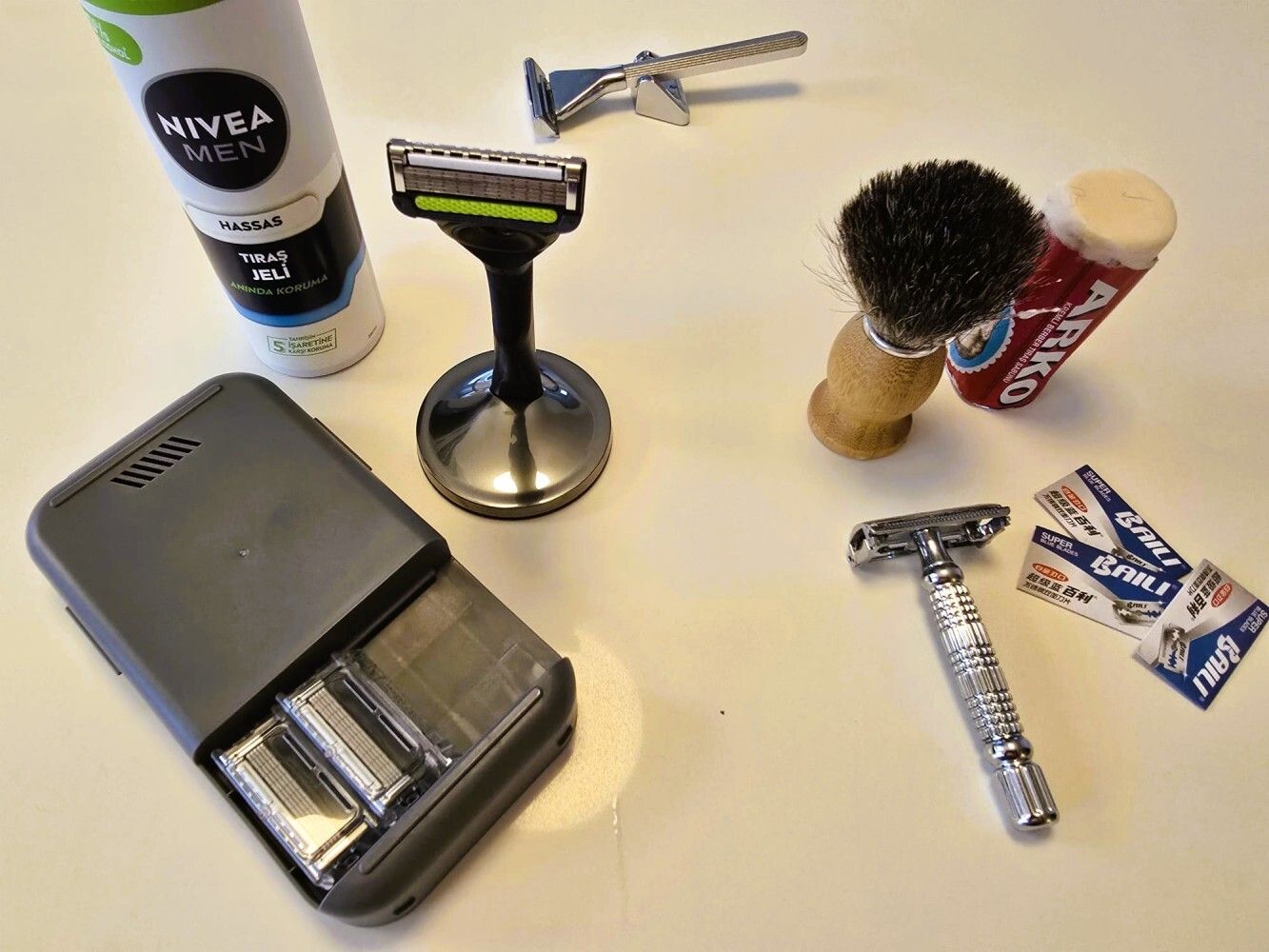
Left: ~39$ for 1-2 months, Bad for you. Right: ~$39$ for 3-5 Years, Good for you.
Health Without the Cult The health market today is just the shaving market all over again—overbuilt, overbranded, and quietly designed to extract rent from your insecurity. Half of what passes as “wellness tech” is subscription billing dressed up as self-care. That’s why I ended up with the simplest, least theatrical stack I could assemble. RingConn (30% off during Black Friday) instead of Oura (I am still testing both along with my Fitbit), for example. Same basic biometrics, none of the monthly tribute payments. I don’t need a cloud service upselling me sleep advice; I need a sensor that doesn’t turn my circadian rhythm into a revenue stream. A bathroom scale that does one thing well—weight—without trying to be a lifestyle coach. BAC water because it’s the unglamorous backbone of peptide use: sterile, bacteriostatic, nothing mystical, just the correct tool for the job. Creatine because it actually works and doesn’t pretend to fix your soul. Barefoot sneakers because engineered footwear—air cushions, shocks, springs, gels, arch control—became the same trap as five-blade razors. The more tech they added, the weaker your feet became. Strip it down and the body wakes back up. All of these things have one thing in common: they don’t ask for attention. They don’t trap you in an ecosystem. They don’t build a dossier on your life. They’re building blocks. Tools. The most inexpensive ones that I found at better quality. The kind of devices that will eventually plug into something far more interesting—when we finally get a real, private, local AI medical layer inside the home. No cloud voyeurism, no data brokers, no nagging subscription dashboard. An actual assistant that sees your vitals, your sleep, your intake, your activity, your biomarkers, and gives you the kind of care that clinicians wish they had time for. And yes, that future is already under construction in the background. But until we get there, this is the pragmatic stack: the minimal, durable, subscription-free foundation that does its job now and doesn’t get in the way of the system coming next. RingConn: https://amzn.to/4acqlWe Scale: https://amzn.to/48o5Nrt BAC Water: https://amzn.to/4psQyEl Creatine: https://amzn.to/48AtJcm Barefoot Sneakers: https://amzn.to/3XSenK2

Ringconn gen 2 & Oura gen 3 along with Charge 6 because I am crazy. I tried to wear these at different body parts too. Ring not advisable at toes, FitBit ok at ankle.
Robots That Actually Work, Not the Ones They Pitch on Stage Most consumer robots are silicon-valley theatre: big promises, tiny motors, a keynote demo that never survives real floors. But a few companies quietly skipped the circus and built machines that just… work. Roborock is one of them. No mythology, no “smart home ecosystem,” no subscription, no personality chip pretending to be your friend. It vacuums. It mops. It doesn’t get lost. It doesn’t panic when it sees a rug. It’s the unglamorous version of automation that actually earns its keep. The Matic might be “the future,” but the future isn’t in my apartment yet. The Roborock https://amzn.to/48jIoHK is, and it does its job without demanding a TED talk.
Electronics That Reduce Friction Instead of Creating More I keep a universal charger https://amzn.to/485Cdbe because I refuse to carry a pouch of proprietary nonsense (stupid Dell laptop thinks this charger is slow because it doesn't have that proprietary handshake - what a scam). This one is cheap enough that it feels like a mistake. It powers everything I own without whining. That’s what technology was supposed to be before every company discovered the recurring-revenue gospel. And the GPS tracker https://amzn.to/4pAEdyg? I need it because I lose things. Wallet, keys, backpack - my environment is an urban Bermuda Triangle. These tiny trackers are the difference between panic and “oh right, I left it on the kitchen counter again.” The next obvious step is to bake the tracker into the object itself. A real leather wallet, stitched by someone who still respects materials, with a tracker hidden inside. Nostalgia on the outside. Quiet telemetry on the inside. A tool that feels like the past but behaves like the future. I should probably build that.
The Quiet Future Under All This All of these devices—robot, charger, tracker—are primitive limbs of the home AI that’s coming. A local assistant, privacy-intact, no cloud addiction, no surveillance capitalism. Something that actually oversees your environment instead of selling it. A system that knows where your wallet is, when the robot ran last, what’s low on battery, what’s broken, what’s missing, and fixes it before you realize it’s a problem. You don’t need a smart home. You need a competent one. For now, this is the starter kit: the robot that works, the charger that behaves, the trackers that actually save you, and the empty space where the real intelligence will sit once we stop outsourcing our lives to adtech servers.